Zero visibility
Dispatchers call drivers because the map shows nothing useful.
Live GPS, job status, and route deviations should update automatically. When they do not, decisions slow down and customers call in to ask where their delivery is.
We build fleet management platforms, dispatch engines, driver apps, and supply chain visibility tools that reduce delays, cut fuel costs, and keep every shipment on track.
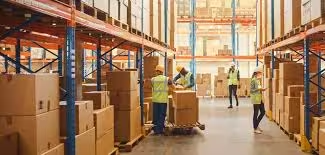
The margin squeeze in logistics rarely comes from one source. It builds slowly through manual dispatch, invisible vehicles, disconnected warehouses, and compliance that lives in spreadsheets.
Zero visibility
Live GPS, job status, and route deviations should update automatically. When they do not, decisions slow down and customers call in to ask where their delivery is.
Paper based ops
Digital signatures, photo capture, and automated compliance logs remove the risk of lost paperwork and manual data entry errors at every delivery point.
Disconnected warehouse
When dispatch does not know warehouse readiness and the warehouse does not see vehicle ETA, both ends wait. Connected systems cut this delay out of every shift.
We design logistics platforms where the driver app, dispatch console, warehouse sync, and customer tracking portal all read from the same live data. One source of truth across the whole operation.
What this platform coordinates
Live GPS, status, and alerts across every vehicle in the operation.
Automated job matching that routes the nearest available driver.
Real time delivery tracking that reduces inbound customer calls.
Every logistics platform we build is designed around the specific workflow of your operation, not a generic trucking template.
GPS positions, speed, heading, idle alerts, and geofence triggers surfaced in a dispatcher friendly console.
Multi stop routing that accounts for load, time windows, driver hours, and road restrictions to cut fuel spend.
Job cards, navigation, digital POD, and two way messaging in a single app that works offline and syncs on reconnect.
Dock scheduling, inbound vehicle ETA, and pick pack status connected directly to the dispatch console.
Branded delivery tracking pages with live updates, ETA windows, and proof of delivery links sent automatically.
Dashboards for fleet utilization, on time performance, fuel costs, and driver productivity across the whole fleet.
We architect logistics platforms with the data flows, APIs, and integration points that allow your operation to scale without adding headcount.
Tracking
Device agnostic tracking that ingests data from hardware trackers, SIM based GPS, and driver phone location.
Dispatch
Rules engine that assigns jobs based on driver availability, load type, zone, and service level agreements.
Compliance
Driver license expiry, vehicle permit renewal, service schedules, and insurance alerts tracked and actioned automatically.
Integration
Bidirectional sync with SAP, Oracle, or custom warehouse management systems for live inventory and order flow.
Alerts
Customer delivery alerts, driver deviation warnings, and supervisor escalations triggered by live operational events.
Security
Dispatcher, driver, warehouse, and client views with granular permissions and full event logging for accountability.
AI Research
Get an independent AI-powered perspective on this service, technology, or business requirement.
Opens in a new tab. Answers come from third-party AI tools and may not be accurate.
We map your current workflows before designing anything. The result is a platform that fits your operation from day one, not a system your team has to adapt around.
We review your current dispatch workflow, fleet size, driver communication patterns, and integration requirements before scoping the build.
We define the platform architecture, data flows, mobile app structure, and integration points so the build phase has no surprises.
Fleet tracking, dispatch console, driver app, and customer portal are built in parallel and connected before handover.
Dispatcher and driver training, live monitoring during the first week, and structured support as the operation transitions off old tools.

Our logistics clients see faster dispatch, lower fuel spend, and fewer missed deliveries within the first 60 days of going live.
28%
Through optimized routing, idle time alerts, and smarter vehicle dispatch.
41%
From automated job assignment replacing manual coordination calls.
35%
Live tracking and automatic customer alerts reduce failed delivery attempts.
3x
Better route density and load balancing across the same vehicle count.
We bring domain knowledge of fleet ops, driver workflows, and warehouse integration into every build so the system works for dispatchers and drivers, not just the dashboard viewer.
A logistics platform should make the dispatcher faster and the driver less distracted. If it does neither, it is not ready to run a live operation.
We design for dispatcher speed and driver simplicity before considering anything else. A beautiful dashboard that slows dispatch is the wrong outcome.
We have connected logistics platforms to SAP, Oracle, custom WMS systems, and third party GPS hardware without disrupting live operations.
We run parallel operation periods, train dispatchers and drivers, and stay engaged through the first live weeks to ensure the transition holds.
Before the next busy season, give your dispatchers live visibility, your drivers a simple mobile workflow, and your operations team the data they need to make decisions without spreadsheets.
These cover the most common platform, integration, and migration questions we hear during early logistics tech conversations.
Yes. Most modern GPS trackers expose data via REST APIs or MQTT streams. We build the platform layer on top of your existing hardware rather than requiring you to replace devices. We support Teltonika, Queclink, Syrus, and most NMEA based devices.
Yes. We build cross platform driver apps that work on both Android and iOS using React Native. We also support offline mode so drivers can continue capturing proof of delivery in areas with no mobile signal, and the data syncs when they reconnect.
Yes. We have integrated logistics platforms with SAP, Oracle NetSuite, Microsoft Dynamics, and custom built warehouse management systems. We build bidirectional APIs so order and inventory data flows without manual export.
We run a parallel operation period where the new platform runs alongside your existing tools. Dispatchers use both until confidence is high, then we cut over. We train both dispatchers and drivers before go live day.
Yes. The customer facing tracking portal is fully brandable with your logo, colors, and domain. Customers never see Ocean Technolab branding in the delivery experience.
Driver license expiry, vehicle permit renewal dates, service schedule tracking, insurance document management, and driver hours of service. Alerts go to the relevant manager before any document expires, not after.
A core platform with fleet tracking, dispatch, and driver app typically takes 10 to 14 weeks. Adding warehouse sync, customer portal, and compliance layers extends the timeline by 4 to 6 weeks depending on integration complexity.
If you are replacing spreadsheets, building on top of basic GPS, or scaling a fleet that has outgrown its current tools, we can map the fastest path to a system that keeps up.