
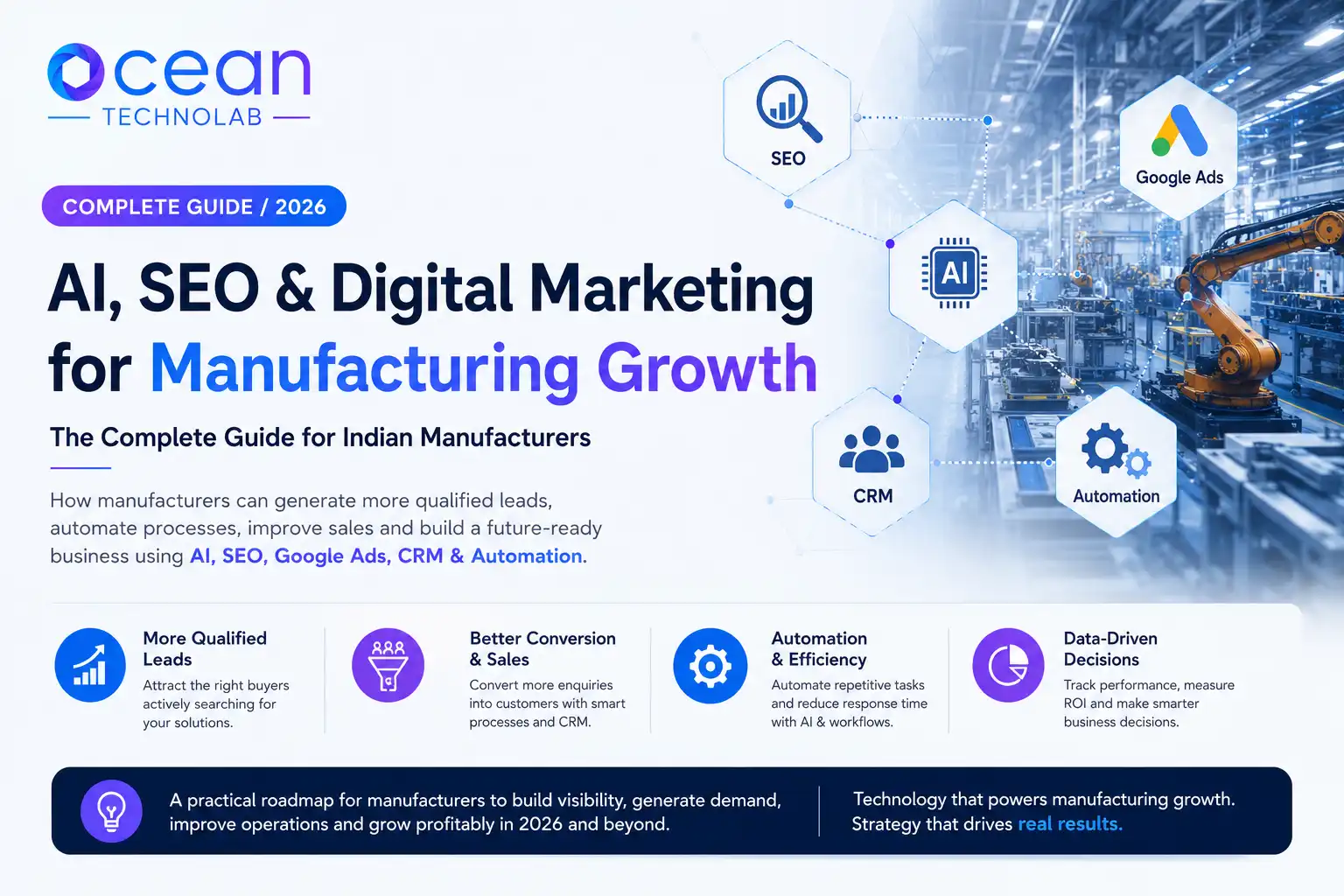
How Indian manufacturing businesses can use AI, SEO, Google Ads, automation, CRM and technology to generate more opportunities, convert more customers and build businesses that are ready for the next decade
India is entering an important phase of its manufacturing journey.
For decades, the conversation around Indian manufacturing was largely about production capacity, labour, machinery, cost advantages and exports.
Those things still matter.
But they are no longer enough.
The next generation of successful manufacturing companies will compete on something much broader:
How efficiently can they find customers, understand demand, respond to opportunities, convert enquiries, automate repetitive work and use data to make better decisions?
That is where technology is becoming much more than an IT investment.
It is becoming a growth investment.
India’s manufacturing sector recorded estimated growth of 7% in FY2026, according to the Government of India’s Economic Survey 2025-26. Manufacturing is also increasingly moving toward higher-technology production, while India’s broader export ecosystem continues to expand. (Invest India)
At the same time, India’s MSME ecosystem represents an enormous opportunity. As of February 2026, more than 7.8 crore MSMEs were registered across the Udyam Registration Portal and Udyam Assist Platform, with MSMEs accounting for a significant share of India’s manufacturing output and exports. (India Brand Equity Foundation)
The opportunity is obvious.
But there is a problem.
A large number of manufacturing businesses are still operating with a digital setup that was designed for a completely different era.
They have a website.
They have a sales team.
They may have a CRM.
They may run some Google Ads.
They may receive enquiries on WhatsApp.
They may have an ERP.
But these systems often don’t work together.
And that gap is where the next big opportunity lies.
The Manufacturing Website Is No Longer Enough
Let’s start with something simple.
A manufacturer spends money building a professional website.
The website looks good.
It has product pages.
It has an About Us section.
It has a Contact Us form.
Maybe there is even a catalogue PDF.
Then the website goes live.
And everyone waits for enquiries.
But a website does not create demand simply because it exists.
A website is infrastructure.
It is not a growth strategy by itself.
Imagine a manufacturer selling industrial machinery.
The company may have 200 different products, applications across multiple industries and customers in India, the Middle East, Europe and the United States.
Someone searches Google for:
“automatic packaging machine manufacturer in India”
Another searches:
“industrial filling machine supplier”
Another searches:
“packaging machinery exporter India”
Another searches for a specific machine model.
Another person may discover the company through LinkedIn.
Another may click a Google advertisement.
Another may receive a recommendation from a distributor.
Another may see a YouTube video.
Another may ask an AI assistant for recommendations.
The customer journey is no longer:
Google → Website → Contact Form
It is becoming:
Search → Content → Website → Product → Enquiry → WhatsApp → Qualification → Sales → Follow-up → Quotation → Conversion
And increasingly:
AI → Search → Website → Conversation → Qualification → CRM → Sales
That is a fundamentally different system.
The Real Problem Indian Manufacturers Need to Solve
Most manufacturers don’t actually need another website.
They need more qualified opportunities.
They need faster responses.
They need better follow-ups.
They need better visibility into their sales pipeline.
They need to understand which products generate demand.
They need to know which countries are showing interest.
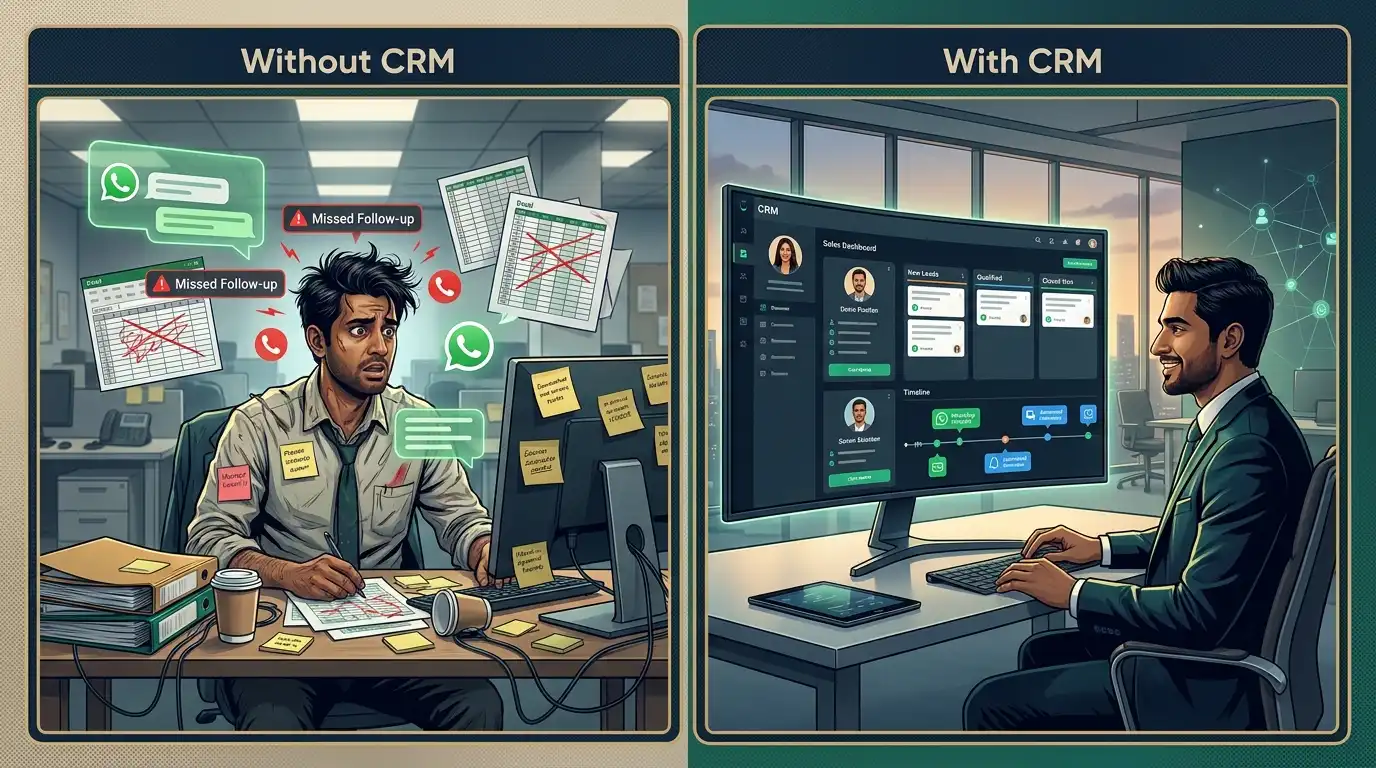
They need to reduce the number of enquiries that disappear after the first conversation.
They need their salespeople spending time on serious opportunities rather than manually answering the same questions every day.
And they need measurable ROI from their marketing.
This changes the question completely.
Instead of asking:
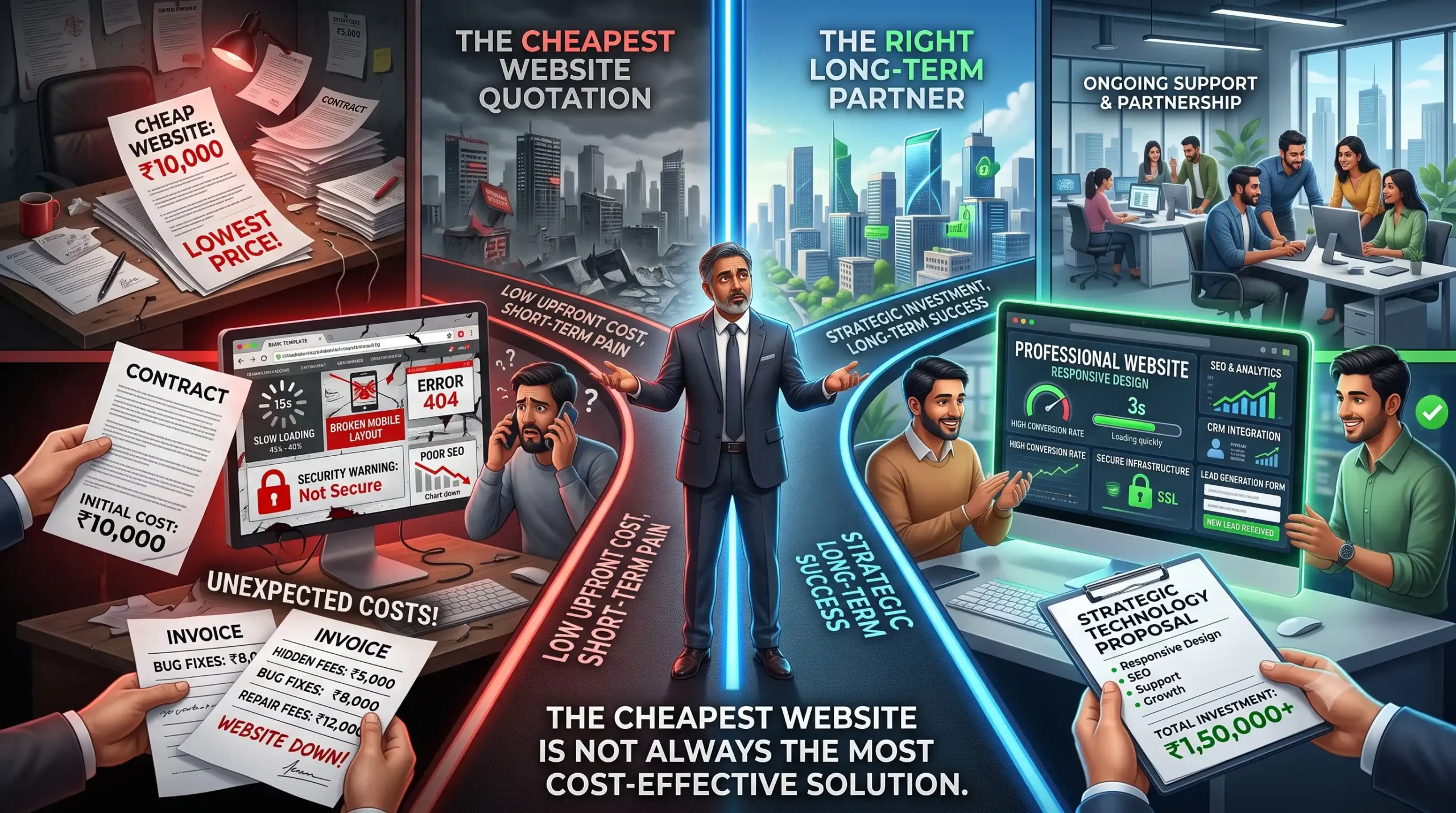
“How much does a website cost?”
Manufacturers should be asking:
“How much revenue can our digital system generate, and how efficiently can we convert those opportunities?”
That is the direction we believe the industry is moving toward.
AI Will Not Replace Manufacturing Businesses
There is a lot of noise around artificial intelligence.
Some businesses think AI is going to replace employees.
Others think AI is just another marketing buzzword.
Both views miss the bigger picture.
AI is most powerful when it becomes part of an existing business process.
Consider a manufacturing company receiving 500 enquiries every month.
An employee may manually read every enquiry.
Identify the product.
Check the customer’s country.
Ask for specifications.
Forward the enquiry to a salesperson.
Wait for a response.
Send a quotation.
Follow up.
Repeat.
Now imagine a system where AI can assist with much of this process.
A new enquiry arrives.
AI identifies the customer requirement.
It categorises the enquiry.
It extracts relevant information.
It checks whether the company has the required product.
It asks the customer for missing information.
It creates a structured lead.
It sends the lead into the CRM.
The sales team receives the qualified opportunity.
The salesperson takes over when human judgment matters.
That is not replacing the salesperson.
It is removing unnecessary administrative work around the salesperson.
This distinction matters.
McKinsey’s research shows that manufacturing is still relatively early in scaling AI compared with some other business functions. That means the opportunity is not simply about using AI tools; it is about identifying practical workflows where AI can create measurable operational or commercial value. (McKinsey & Company)
The Five Areas Where AI Can Transform a Manufacturing Business
For most manufacturers, I would start with five areas.
1. Lead Generation
AI can help identify:
- Which products have growing demand
- Which keywords customers use
- Which markets are searching for specific products
- Which content attracts potential buyers
- Which advertising campaigns generate qualified enquiries
- Which countries are producing the best leads
This information can influence both marketing and business strategy.
2. Lead Qualification
Not every enquiry deserves the same sales effort.
One person may submit:
“Send catalogue.”
Another may submit:
“We need an automatic 5000 bottles/hour filling and capping line for our facility in Kenya. Please share pricing, specifications and installation timeline.”
Those are completely different opportunities.
AI can help classify leads based on:
- Product requirement
- Industry
- Location
- Budget
- Quantity
- Application
- Timeline
- Company size
- Purchase intent
The sales team can then prioritise accordingly.
3. Customer Support
Manufacturers answer the same questions repeatedly.
What is the capacity?
What is the power requirement?
What material does the machine support?
What is the production speed?
What is the delivery time?
Do you provide installation?
Do you export?
What certifications are available?
A properly designed AI assistant can answer many basic questions instantly using the company’s approved product information.
The important word is properly .
The AI should not invent technical specifications.
It should work from controlled company information, product databases, catalogues, documentation and approved knowledge sources.
4. Sales Follow-up
This may be one of the biggest opportunities.
A manufacturing enquiry comes in.
The salesperson replies.
The customer does not respond.
Three days pass.
Then a week.
Then the lead disappears.
This happens constantly.
AI and automation can help create structured follow-up workflows.
For example:
Day 0: Enquiry received
Day 0: Immediate acknowledgement
Day 1: Product information sent
Day 3: Follow-up
Day 7: Application-specific information
Day 14: Case study or relevant product
Day 30: Re-engagement
The objective isn’t to spam customers.
It is to ensure genuine opportunities don’t disappear simply because somebody forgot to follow up.
5. Internal Knowledge
Manufacturing businesses often have enormous amounts of information.
PDFs.
Product catalogues.
Machine manuals.
Technical specifications.
SOPs.
Installation documents.
Price lists.
Old quotations.
Frequently asked questions.
Sales presentations.
Yet much of that knowledge is difficult to access.
AI can turn this information into an internal knowledge assistant.
A salesperson could ask:
“Which machine should we recommend for a customer producing 2,000 units per hour?”
Instead of searching through folders and PDFs, the system can help retrieve the relevant information.
This is where AI starts becoming part of the company’s operating system rather than another chatbot sitting on a website.
But AI Alone Will Not Solve the Problem
This is important.
AI is only one part of the equation.
A manufacturer can install the best AI system in the world and still fail to generate business if nobody can find the company.
That brings us to digital marketing.
SEO Will Become More Important, Not Less
Search is changing.
People are using traditional Google search.
They are also using AI-powered search and conversational assistants.
But the underlying requirement remains the same:
Businesses need to be discoverable when customers are looking for solutions.
For manufacturers, this creates a huge opportunity.
Many industrial websites are extremely weak from a search perspective.
They might have:
- Five product pages
- A generic homepage
- A contact page
- A downloadable catalogue
- No meaningful educational content
That is not enough to capture modern search demand.
Imagine a company manufacturing industrial equipment.
Instead of creating one page called:
Industrial Machines
it could create useful content around actual customer questions:
- How to choose an industrial filling machine
- Automatic vs semi-automatic filling machines
- How filling capacity affects production
- Packaging machinery for pharmaceutical companies
- Packaging machinery for food manufacturers
- How to calculate machine production capacity
- Industrial machinery export requirements
- Machine maintenance checklist
- How to reduce production downtime
- Manufacturing automation trends
Now the website isn’t simply a brochure.
It becomes a knowledge resource.
And knowledge creates discoverability.
Google Ads Still Matter
SEO is powerful.
But SEO takes time.
Manufacturers often need leads now.
That is where Google Ads can play an important role.
A properly structured Google Ads campaign can target people who are actively searching for products and solutions.
But there is a major difference between running ads and running a lead-generation system.
Bad approach:
Keyword → Ad → Generic Homepage
Better approach:
Keyword → Relevant Product/Application Page → Clear Value Proposition → Enquiry → Qualification → CRM → Sales Follow-up
The second approach gives you much more control.
And the most important metric isn’t clicks.
It isn’t impressions.
It isn’t even enquiries.
The real metric is:
Qualified opportunities and revenue generated.
The Manufacturer’s Digital Growth Engine
This is where everything comes together.
Think about the following system:
Traffic
Google Search Google Ads SEO LinkedIn YouTube Industry directories Referrals AI search
↓
Website
Product pages Industry pages Application pages Technical content Case studies Landing pages
↓
Conversion
Forms WhatsApp Phone Live chat AI assistant Downloadable catalogues
↓
Qualification
AI Lead scoring CRM Product matching Country Industry Purchase intent
↓
Sales
Salesperson Quotation Technical consultation Demo Negotiation
↓
Automation
Follow-ups Reminders WhatsApp Email Lead nurturing
↓
Analytics
Cost per lead Qualified leads Conversion rate Sales pipeline Revenue Customer acquisition cost
That is a digital growth system .
And this is where the opportunity becomes much bigger than website development.
From Website Developer to Growth Technology Partner
This distinction is important for us at Ocean Technolab.
A traditional software company might say:
“We build websites.”
A digital marketing agency might say:
“We run Google Ads and SEO.”
A CRM company might say:
“We provide lead management software.”
An AI company might say:
“We build AI agents.”
But a manufacturing business doesn’t necessarily want four different vendors.
It wants the problem solved.
It wants more qualified enquiries.
It wants better conversion.
It wants salespeople to work efficiently.
It wants visibility.
It wants growth.
That creates an opportunity for a different kind of technology partner.
At Ocean Technolab, our long-term direction is to help businesses move toward that model.
Not simply building websites.
Not simply running advertisements.
Not simply developing software.
But bringing these capabilities together around a measurable business objective.
Why Manufacturing?
There are thousands of industries a technology company could target.
So why manufacturing?
Because manufacturing has something incredibly valuable:
Real, measurable business processes.
A manufacturer sells a physical product.
There is usually a clear enquiry.
There is a quotation.
There is a sales cycle.
There is an order.
There is a production process.
There is delivery.
There is repeat business.
There are distributors.
There are export markets.
There are measurable economics.
That makes manufacturing particularly interesting for technology-driven transformation.
India is also actively pushing deeper integration into global value chains and higher-value manufacturing. The country’s manufacturing sector is becoming increasingly technology-driven, while medium- and high-technology industries represent a growing share of manufacturing value added. (India Brand Equity Foundation)
The Opportunity for Indian Manufacturers
There is another important shift happening.
Indian manufacturers are not only competing with companies next door.
They are competing globally.
A manufacturer in Gujarat can sell to:
- United States
- United Kingdom
- Germany
- UAE
- Saudi Arabia
- Africa
- Australia
- Southeast Asia
The internet has removed much of the geographical barrier.
But that creates a new requirement.
A manufacturer has to look global online.
A buyer in Germany doesn’t care that your factory is in Gujarat.
They care whether you appear credible.
They want:
- Professional documentation
- Clear product information
- Technical specifications
- Certifications
- Case studies
- Customer references
- Fast responses
- Transparent communication
- Professional digital presence
Your website becomes part of your sales team.
Your Google visibility becomes part of your sales team.
Your content becomes part of your sales team.
Your CRM becomes part of your sales team.
And increasingly, your AI systems become part of your sales team.
The Biggest Mistake: Buying Technology Without a Strategy
There is a temptation to buy everything.
CRM.
ERP.
AI chatbot.
Marketing automation.
Google Ads.
SEO.
WhatsApp automation.
Analytics.
Dashboards.
But technology without strategy creates complexity.
The question should always be:
What business problem are we solving?
For example:
Problem
Salespeople are spending too much time answering repetitive questions.
Solution
AI knowledge assistant.
Measurement
Time saved per salesperson.
Problem
Website receives traffic but very few enquiries.
Solution
Conversion optimisation + better landing pages + clearer offers.
Measurement
Visitor-to-lead conversion rate.
Problem
Large number of enquiries but poor conversion.
Solution
Lead qualification + CRM + structured follow-up.
Measurement
Qualified lead-to-opportunity and opportunity-to-sale conversion.
Problem
Google Ads generates many low-quality enquiries.
Solution
Better keyword strategy + negative keywords + landing pages + lead qualification.
Measurement
Cost per qualified opportunity.
This is how technology investment should be evaluated.
A Practical 12-Month Roadmap for Manufacturers
A manufacturer does not need to transform everything overnight.
A sensible roadmap could look like this.
Months 1–2: Build the Foundation
Audit:
- Website
- SEO
- Google visibility
- Existing advertising
- Lead sources
- CRM
- Sales process
- Product data
- Analytics
Then identify the biggest bottleneck.
Months 3–4: Fix Digital Discovery
Build:
- Product pages
- Industry pages
- Application pages
- SEO content
- Technical content
- Conversion-focused landing pages
Set up proper analytics.
Start measuring where leads are coming from.
Months 5–6: Build Lead Generation
Launch or improve:
- Google Ads
- SEO
- Remarketing
- Content marketing
But focus on qualified opportunities rather than vanity metrics.
Months 7–8: Connect the CRM
Every meaningful enquiry should have a home.
Track:
- Source
- Product
- Country
- Industry
- Salesperson
- Stage
- Value
- Next action
- Probability
- Outcome
Now management can finally see the pipeline.
Months 9–10: Add Automation
Automate:
- Lead notifications
- Follow-ups
- WhatsApp communication
- Email sequences
- Reminders
- Lead assignment
- Reporting
Reduce repetitive work.
Months 11–12: Introduce AI
Start with practical use cases.
Not an AI demo.
A real business workflow.
For example:
AI Lead Qualification
or
AI Product Recommendation
or
AI Sales Assistant
or
AI Customer Support
or
AI Internal Knowledge Assistant
Then measure the result.
What the Next Generation of Manufacturing Companies Will Look Like
I don’t think the winning manufacturer of 2030 will simply be the company with the biggest factory.
It will increasingly be the company that combines:
Manufacturing capability + data + technology + distribution + digital demand generation.
Imagine a manufacturing company where:
A potential customer searches Google.
↓
The company appears organically.
↓
The customer visits a product page.
↓
An AI assistant answers technical questions.
↓
The customer submits an enquiry.
↓
AI qualifies the lead.
↓
The CRM assigns it to the right salesperson.
↓
The salesperson receives the complete customer context.
↓
A quotation is generated faster.
↓
Automated follow-ups keep the opportunity alive.
↓
Management sees the opportunity in the pipeline.
↓
Marketing can see which campaign generated the customer.
↓
Finance can eventually connect revenue back to acquisition cost.
That is a very different business from a company that simply has a website.
AI + SEO + Google Ads + CRM Is More Powerful Together
These technologies should not be viewed as separate services.
They reinforce each other.
SEO brings long-term organic demand.
Google Ads captures immediate intent.
Content builds authority.
The website converts attention into enquiries.
AI qualifies and assists.
CRM manages the opportunity.
Automation improves follow-up.
Analytics tells management what is working.
The result is a connected growth loop.
Traffic → Leads → Qualification → Sales → Revenue → Data → Better Marketing → More Leads
That loop is what businesses should be building.
What Ocean Technolab Wants to Build
This is also where our own journey becomes important.
Ocean Technolab has worked across software development, websites, e-commerce, CRM, automation, digital marketing and technology.
But there is a natural evolution.
Instead of asking:
“What technology can we sell?”
we should be asking:
“What business outcome can we help create?”
That is a much harder question.
And a much more valuable one.
For manufacturing businesses, the answer could be:
More qualified leads.
Better digital visibility.
Faster sales response.
Higher conversion.
Less manual work.
Better customer communication.
Better use of data.
Smarter operations.
And ultimately:
More profitable growth.
Our vision is to bring these pieces together.
Website development can be part of it.
SEO can be part of it.
Google Ads can be part of it.
CRM can be part of it.
WhatsApp automation can be part of it.
AI can be part of it.
Custom software can be part of it.
But none of those should be the final product.
The final product is business growth through technology.
The Future Is Not About More Software
This may sound strange coming from a technology company.
But businesses don’t need more software.
They need fewer problems.
A manufacturer doesn’t wake up thinking:
“I need another CRM.”
They wake up thinking:
“Why aren’t we getting enough enquiries?”
“Why are competitors appearing above us on Google?”
“Why are our salespeople not following up?”
“Why are customers asking the same questions repeatedly?”
“Why does it take three days to send a quotation?”
“Which products are actually generating demand?”
“Which countries should we target?”
“Why are we spending ₹2 lakh on marketing and not knowing what came from it?”
Those are the problems worth solving.
Technology is simply the mechanism.
The Manufacturer’s Competitive Advantage Will Change
Historically, competitive advantage might have come from:
- Better machinery
- Lower manufacturing cost
- Better raw material sourcing
- Skilled employees
- Distribution
- Relationships
Those remain important.
But a new layer is emerging.
Digital intelligence.
The ability to understand customers.
The ability to capture demand.
The ability to respond instantly.
The ability to automate.
The ability to learn from data.
The ability to use AI responsibly.
The ability to continuously improve the sales process.
That could become a significant competitive advantage.
Start Small. Measure Everything.
There is no reason for a ₹10 crore manufacturer to spend ₹1 crore attempting a digital transformation.
Start with one problem.
For example:
Generate 50 qualified international enquiries per month.
Then build the system around that goal.
Or:
Reduce lead response time from 4 hours to 10 minutes.
Or:
Increase website enquiry conversion from 1% to 3%.
Or:
Reduce sales administration by 20%.
When the result is measurable, technology becomes much easier to justify.
The Bigger Vision
India has an enormous manufacturing opportunity.
The country is expanding its role in global supply chains.
Manufacturing is growing.
Exports are growing.
Technology adoption is accelerating.
AI is becoming more accessible.
And millions of businesses are still in the early stages of digital transformation. (India Brand Equity Foundation)
That combination creates a rare opportunity.
The next decade will not belong only to companies that manufacture better.
It will belong to companies that manufacture better and sell smarter.
And selling smarter increasingly means combining:
AI
SEO
Google Ads
Content
Web technology
CRM
Automation
Analytics
Human expertise
into one connected system.
Our Commitment at Ocean Technolab
At Ocean Technolab, we want to be part of that transition.
Our goal is not to become another agency that sells a website, sends a monthly SEO report and disappears.
We want to work closer to the business.
Understand the products.
Understand the customers.
Understand the sales process.
Understand the market.
Understand where the company is losing opportunities.
Then use technology to fix those problems.
Sometimes the answer will be SEO.
Sometimes Google Ads.
Sometimes a better website.
Sometimes CRM.
Sometimes WhatsApp automation.
Sometimes custom software.
Sometimes AI.
And sometimes the answer will simply be fixing a broken process before adding another piece of technology.
That is the mindset we want to build.
A Note to the Manufacturing Business Owner Reading This
If you run a manufacturing business, you don’t need to become a technology expert.
You don’t need to understand every AI model.
You don’t need to learn SEO.
You don’t need to become a Google Ads specialist.
You don’t need to build your own CRM.
Your job is to understand your business.
Your technology partner’s job is to understand technology.
But both sides need to understand the outcome.
So start with these questions:
Where are our best leads coming from?
How many qualified enquiries do we receive every month?
How quickly do we respond?
How many enquiries become quotations?
How many quotations become orders?
Which products generate the highest-value opportunities?
Which countries generate the best customers?
How much does it cost us to acquire a customer?
How much revenue does our digital marketing generate?
Which repetitive sales and customer-service tasks could be automated?
If you cannot answer these questions today, that is not a failure.
It is an opportunity.
Because the first step toward a smarter manufacturing business is knowing where you are starting.
The Goal for the Next Decade
The goal isn’t to replace people with AI.
The goal isn’t to automate everything.
The goal isn’t to install the newest technology.
The goal is simpler:
Build a manufacturing business that can find opportunities, understand customers, respond quickly, operate efficiently and make better decisions.
Technology can help make that possible.
AI can accelerate it.
Digital marketing can create demand.
SEO can create long-term visibility.
Google Ads can capture immediate intent.
CRM can create sales discipline.
Automation can remove repetitive work.
Data can create visibility.
And people can make the decisions that matter.
That combination is powerful.
The Future Belongs to Manufacturers Who Adapt Early
The manufacturing companies that start experimenting today will have an advantage over companies that wait until these technologies become standard.
They don’t need to transform everything tomorrow.
They need to start.
One process.
One product.
One market.
One campaign.
One automation.
One AI use case.
Then measure.
Learn.
Improve.
Repeat.
That is how transformation actually happens.
Not through one giant technology project.
Through hundreds of small improvements that eventually change how the business operates.
Final Thought
The next chapter of Indian manufacturing will not be written only on the factory floor.
It will also be written in search results.
In Google Ads.
In WhatsApp conversations.
Inside CRMs.
In customer data.
In AI systems.
In automated workflows.
And in the decisions business owners make using all of that information.
The companies that connect these pieces will have a very different kind of competitive advantage.
They won’t simply manufacture products.
They will build intelligent businesses around those products.
And that is the direction we believe Indian manufacturing is heading.
At Ocean Technolab, we want to help build that future.
Not by selling technology for the sake of technology.
But by using technology to solve real business problems.
Because ultimately, the question isn’t:
“What software should we buy?”
The better question is:
“What could our business achieve if technology worked for us?”
That is the question worth answering.
About Ocean Technolab

Ocean Technolab is a technology and digital growth company based in India, helping businesses build and improve their digital presence through websites, software, CRM, automation, SEO, digital marketing and emerging AI technologies.
Our long-term focus is simple:
Help businesses use technology not just to look digital, but to become more efficient, more discoverable and more capable of generating and converting business opportunities.
If you are a manufacturing business looking at how AI, SEO, Google Ads, CRM or automation can contribute to measurable growth, the starting point should not be another technology demo.
It should be a conversation about your business.
What are you trying to achieve, and what is currently stopping you?