

The modern world is completely dependent on the Internet for almost everything.
Feeling like catching up on the latest headlines? You jump onto a news portal and browse through stories. In the mood for some entertainment? Video streaming platforms like YouTube are just a tap away. Looking to kill some time? You launch your favorite game and dive right in. Just arrived at a breathtaking location and want to share the moment? Social media is there to let the world know. Need a wardrobe upgrade? Online shopping platforms let you buy anything from the comfort of your couch.
No matter what you want to accomplish, the Internet is your go-to solution. A handful of clicks is all it takes to get things done. Life has genuinely become far more convenient and efficient thanks to seamless digital accessibility. But have you ever stopped to think about what actually powers all of this? Behind every smooth online experience are two fundamental building blocks — websites and web applications.
Most people never really think about whether they are using a website or a web application. As long as they find what they are looking for within moments, the technical distinction does not seem to matter. However, understanding the difference between the two is quite valuable, especially if you are planning to build a digital presence for your business.
Let us break both concepts down and explore how they differ from one another.
What Exactly is a Website?
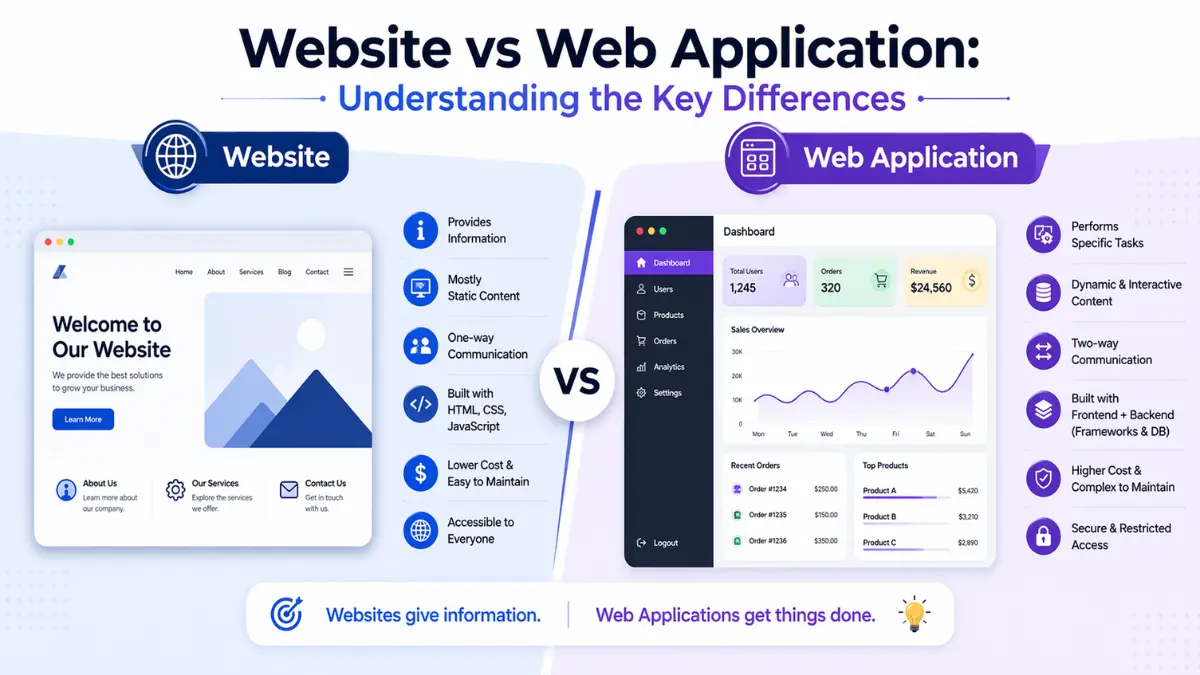
A website is essentially a collection of interconnected web pages — whether it is just one page or hundreds of them — all tied together under a single domain name. These pages can contain a wide variety of content including written text, photographs, graphics, audio clips, and video material. Anyone with an internet connection can visit a website by simply entering its URL into a browser like Chrome, Safari, or Firefox, regardless of where they are in the world. The experience, however, is largely one-directional — visitors can browse through the content and absorb information, but they cannot directly influence or change anything on the site.
To put it in practical terms, imagine you are searching for a digital marketing agency in your city. You type a relevant search phrase into Google and a list of results appears. You click on one of the company websites and browse through their service offerings, team details, and portfolio. That entire experience of viewing and reading constitutes interacting with a website.
What Exactly is a Web Application?
A web application is a far more sophisticated digital tool. It is essentially a software program that runs through a web browser rather than needing to be downloaded and installed on your device. What sets a web app apart is its ability to store and process data dynamically while offering users the ability to create, modify, and delete content based on their actions.
Think about YouTube as an example. You do not just passively watch videos there — you can upload your own content, remove videos you have posted, leave comments, like or dislike content, manage playlists, and much more. That level of active participation and dynamic interaction is what defines a web application. The platform responds to what you do and changes accordingly.
How Do Websites and Web Applications Differ?
Purpose Behind Creation
Websites are primarily built to communicate. Businesses, individuals, organizations, and government bodies use them to showcase what they offer, establish credibility, and build brand recognition. A well-designed website tells your audience who you are, what you do, and why they should trust you. It is a powerful tool for attracting new customers and keeping existing ones engaged.
Web applications, on the other hand, are built to perform. Rather than just informing users, they empower users to actually accomplish something — whether that is completing a purchase, managing a project, booking a flight, or filling out a form. They run entirely through a browser, which means users on mobile phones, tablets, or desktops can all access the same functionality without needing to install anything. Updates and changes to the app are applied seamlessly without requiring users to do anything on their end, making maintenance far more straightforward for businesses.
Accessibility
Both websites and web applications are publicly accessible through a URL from any location at any time. However, the nature of that access differs. A website simply lets you view its content. A web application lets you interact with it, input data, and receive personalized responses based on your actions.
Simplicity vs Complexity
Navigating a website is typically very straightforward. The content is presented in an organized manner and users move from one page to another with ease. There is not much happening under the hood beyond serving up static or semi-static content.
Web applications involve a significantly higher level of complexity. They need to handle large volumes of data, execute transactions, process user inputs, and ensure that sensitive information is protected at all times. This demands robust back-end infrastructure, strong security protocols, and advanced data management capabilities.
Functionality
On a website, users are purely consumers of content. They can watch a video, read an article, or view a photo gallery, but their actions do not change anything on the platform itself.
On a web application, users are active participants. They can shop for products, make payments, register for events, submit forms, interact with other users, and much more. The platform adapts and responds based on each user’s inputs and behaviors.
Development Process
Building and launching a website is a relatively streamlined process. You develop your content, structure your pages, and set up the architecture. Any modifications or updates simply involve editing the HTML or related code, and those changes show up on the site immediately without any additional steps.
Developing a web application is considerably more involved. The entire application needs to be precompiled before it can be deployed. Developers must build out multiple features, define different user roles and permissions, and implement robust security measures. Any future changes require the application to be recompiled and redeployed, which demands more time and technical expertise.
Technologies Used
Websites are typically built using foundational technologies like HTML, CSS, and basic JavaScript. These are enough to create clean, functional, and visually appealing pages.
Web applications require all of those same technologies, plus additional layers such as web development frameworks, server-side programming languages, databases, and APIs. Because the user experience is central to a web app’s success, significant attention is also given to UI and UX design to ensure the interface is intuitive and enjoyable to use.
Level of Interaction
Websites offer no real interactive exchange between the platform and its visitors. Users read, watch, or listen — and that is essentially where the engagement ends. The primary focus for a website owner is therefore on the quality, accuracy, and visual appeal of the content.
Web applications are built entirely around interaction. The user interface becomes the core product, and every design and development decision revolves around making that interface as smooth and user-friendly as possible. A confusing or clunky web app will drive users away, no matter how powerful its back-end functionality might be.
Nature of the Software
A website stands on its own as a complete, self-contained product. You visit it, consume its content, and leave.
A web application, technically speaking, is not a standalone product. It functions as a component within the broader digital ecosystem and is typically embedded within or connected to a website.
Authentication Requirements
Most websites do not require users to log in. At most, they might invite visitors to subscribe to a newsletter, leave a comment on a blog post, or sign up for updates.
Web applications almost always require authentication. Because they handle sensitive user data — such as personal information, financial details, or account histories — it is essential to verify who is accessing the system. Without valid credentials, users simply cannot gain entry, which is a necessary safeguard against data breaches and unauthorized access.
Cost Considerations
Hosting a website is generally more affordable since it relies on basic web technologies and does not demand extensive server resources.
Web applications are more expensive to build and maintain. They require advanced features, robust data storage solutions, processing capabilities, and stronger security infrastructure. All of these factors drive up both the initial development costs and the ongoing operational expenses.
Technical Pre-Requirements
To access a website, all a user needs is a web browser and an internet connection. Websites can be hosted on a single server or distributed across multiple servers and accessed via a standard URL or IP address.
Web applications involve a more complex technical setup. User requests are handled through dedicated servers, and the interplay between server-side back-end scripts and client-side front-end scripts is what delivers the dynamic, personalized experience that makes web apps so powerful.
So, Which One Do You Need?
After examining all eleven differences, one thing is clear — neither websites nor web applications are inherently superior to the other. Each serves a distinct purpose, and the right choice depends entirely on what you are trying to achieve.
If your goal is to establish an online presence, communicate your brand story, and inform potential customers about your products or services, a website is the right path forward.
If your goal is to engage users in meaningful ways, help them complete tasks, process transactions, or provide a personalized digital experience, then a web application is the more suitable choice.
Understanding this distinction upfront will save you a great deal of time, money, and confusion as you plan your digital strategy.