
The rapid growth of internet usage, the digitalization of everyday life, and the explosive rise of social media have collectively driven a massive surge in online transactions across the globe. Nowhere is this shift more visible than in the world of online shopping. By 2020, over two billion people were regularly purchasing products and services through digital platforms.
The Covid-19 pandemic acted as a powerful accelerator for this already growing trend. With social distancing measures in place, people confined to their homes, and remote working becoming the new norm, consumers turned to online shopping like never before. The result was a staggering 22 billion monthly visits to global retail eCommerce platforms in June 2020 alone. The pandemic fundamentally reshaped how people around the world shop, pay, and interact with businesses — and those changes are here to stay.
With such an enormous and ever-expanding customer base living and spending online, businesses simply cannot afford to remain offline. Whether you already operate a physical store or are launching a brand new venture, establishing an eCommerce presence is no longer optional — it is essential. An eCommerce website opens doors to entirely new markets, helps you connect with broader audiences, and builds meaningful brand recognition on a global scale.
However, simply deciding to go online is just the first step. To truly take control of your digital business and run it the way you envision, you need a dedicated eCommerce website built specifically around your goals. And one of the most critical decisions you will make during that process is choosing the right eCommerce framework. That choice will shape everything from how your store looks and functions to how easily it can grow with your business.
To make a well-informed decision, let us explore what an eCommerce framework actually is, the different types available, and which options currently stand out in the market.
What is an eCommerce Framework?
At its core, an eCommerce framework is the software foundation upon which your online store is built. Think of it as the digital equivalent of the physical structure of a brick-and-mortar shop — it determines how everything is organized, how transactions take place, and how customers experience your brand.
A good eCommerce framework handles both the front-end and back-end needs of your online store seamlessly. On the back end, it gives you the tools to manage your product inventory, track orders, handle accounting, and deliver customer support. On the front end, it creates the shopping environment that your customers navigate — browsing products, adding items to their cart, and completing their purchases. In essence, it brings your entire online store to life.
Types of eCommerce Frameworks
There are three primary categories of eCommerce frameworks, each with its own set of strengths and trade-offs.
Open Source
Open source frameworks are freely available to anyone who wants to download, install, and customize them. This makes them an attractive option for businesses that want maximum flexibility without an upfront licensing fee. However, working with open source platforms typically requires a solid level of technical knowledge and advanced coding skills. You will need experienced developers to get the most out of them. Additionally, since security is not handled by a central provider, businesses using open source frameworks often need to invest separately in security measures and ongoing maintenance.
SaaS (Software as a Service)
SaaS eCommerce platforms operate on a subscription model, meaning you pay a recurring fee to use the software rather than owning it outright. These platforms are known for their high scalability and built-in security features, making them a smooth and reliable option for many businesses. Managing back-end processes tends to be more straightforward on SaaS platforms, reducing the technical burden on your team. The trade-off, however, is cost. SaaS solutions often come with layered pricing structures that include subscription fees, transaction fees, and additional charges for third-party integrations and plug-in applications.
Headless Commerce
Headless commerce is a more advanced and flexible approach where the front-end presentation layer and the back-end operational layer of your eCommerce site are completely decoupled. This separation gives you extraordinary freedom to design your customer-facing experience however you like, while independently managing your back-end systems. The downside is cost — maintaining separate front-end and back-end frameworks along with dedicated development work can get expensive. That said, this architecture allows for rapid changes and updates without disrupting the overall system, making it a powerful choice for businesses with complex or evolving needs.
Top eCommerce Frameworks Worth Considering
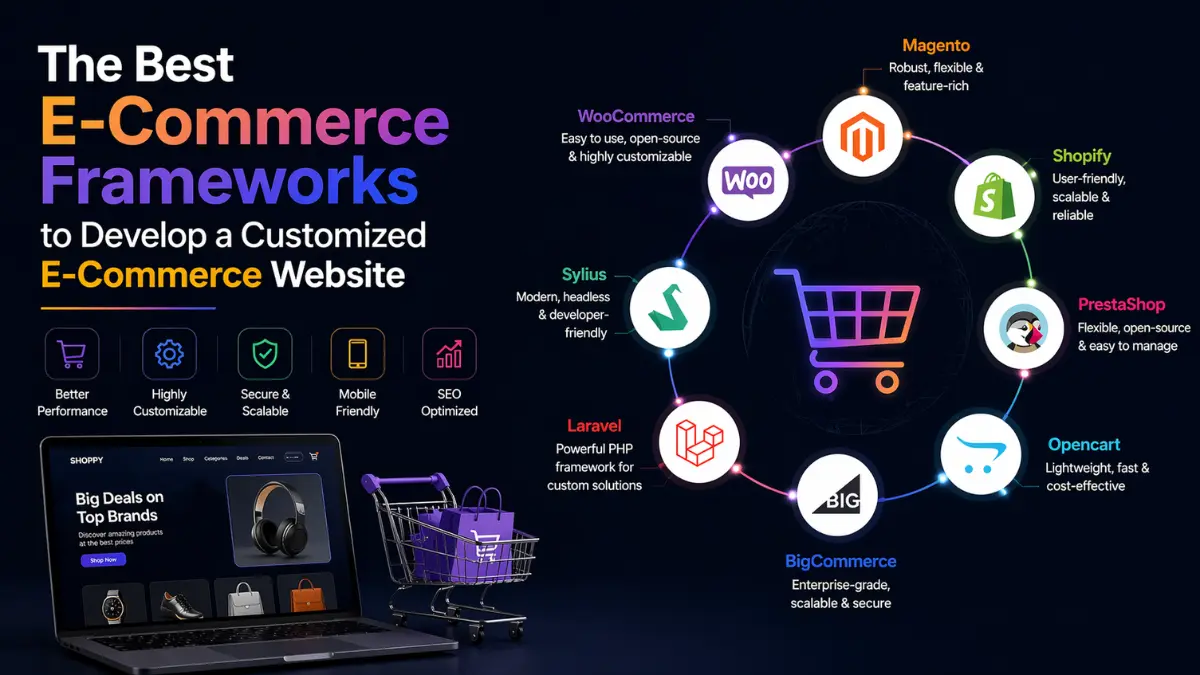
The framework you ultimately choose will depend on your specific business requirements, your budget, your technical capabilities, and your long-term growth plans. Regardless of which platform you go with, make sure it covers the essentials: product management, mobile commerce support, built-in SEO tools, integration and plug-in capabilities, and strong security protocols.
Here are three of the most widely used and respected eCommerce frameworks available today.
Shopify
Shopify has become virtually synonymous with eCommerce, and for good reason. It is widely regarded as the best starting point for small businesses that want to get an online store up and running quickly and without much technical hassle. Its drag-and-drop interface and fast-loading infrastructure make website building an approachable task even for those without a technical background.
Store owners can independently manage product listings, payment integrations, and visual customization all from a single dashboard. Shopify’s app store offers a rich selection of themes — both free and premium — along with a wide variety of extensions and plug-ins to enhance your store’s functionality. Security is another strong point, with 256-bit SSL encryption and PCI compliance built right in. The platform is also fully responsive, meaning you can manage and update your store from any device.
That said, Shopify does come with its limitations. After a 14-day free trial, you are required to pay monthly subscription fees on top of transaction fees. Many of the most powerful one-click selling apps in the ecosystem come with hefty price tags. Perhaps more significantly, Shopify websites have historically struggled with SEO performance, which can be a serious drawback in a digital landscape where organic search visibility is crucial. Hiring developers to implement advanced custom features can also add considerably to your overall costs.
Magento
Magento is the platform of choice for larger, more established businesses that require a high degree of customization and control. If you are looking to build a fully tailored eCommerce experience that reflects your brand identity down to the finest detail, Magento is a compelling option. However, it is not a platform you can manage on your own — it demands experienced developers and a significant amount of custom coding to operate effectively.
The basic community edition of Magento is available at no cost, but the enterprise version carries a substantial annual price tag. For well-resourced, tech-forward businesses, this investment is often well justified. For startups or businesses with limited budgets, it can be a risky financial commitment.
On the feature front, Magento is exceptionally rich. It offers seamless integration with a vast marketplace of third-party extensions and applications, powerful built-in SEO capabilities, and the kind of scalability that allows your platform to handle up to 80,000 orders per hour. It is highly customizable, durable, and spacious enough to grow alongside even the most ambitious business.
Magento also benefits from one of the largest and most active developer communities in the eCommerce world, providing businesses with reliable support and resources. Additional highlights include mobile-friendly configuration, flexible hosting options, versatile content management, adjustable security permissions, and support for recurring payment models.
The platform is not without its drawbacks, however. All of that power and flexibility comes with demanding memory and storage requirements, which can cause performance slowdowns if not properly managed. Premium themes tend to be expensive, though costs can sometimes be offset by sharing custom-built extensions across multiple users.
WooCommerce
WooCommerce occupies a unique position in the eCommerce landscape — it is not a standalone framework but rather a free plug-in built for WordPress. If you already have a WordPress website, WooCommerce allows you to transform it into a fully functional online store without any additional platform cost. Bear in mind, though, that enriching your store with advanced features will require paid extensions and integrations.
For small businesses with modest product catalogs and manageable traffic levels, WooCommerce is an excellent and cost-effective solution. However, as your store scales up — with more products, more plug-ins, and heavier traffic — the platform can begin to show its limitations. Performance may degrade, and you may find yourself needing to invest in a more capable hosting environment to keep things running smoothly, which can drive up costs considerably.
From a security standpoint, WooCommerce is solid, and the WordPress foundation it runs on is widely regarded as SEO-friendly, which is a significant advantage. Customization is also very much possible, though almost every enhancement requires a separate extension.
For existing WordPress users, getting started with WooCommerce is genuinely simple. Install the plug-in, add your products, set up a few extensions, and your store is essentially ready to go. The interface feels familiar and intuitive for anyone already comfortable with WordPress. For those who have no prior experience with WordPress, however, navigating the technicalities of hosting, theme selection, and extension management can feel overwhelming and time-consuming.
Final Thoughts
Beyond the three platforms covered above, the eCommerce framework landscape is broad and varied. Other notable options include BigCommerce, 3DCart, Shift4Shop, Kibo, Zyro, Yo!Kart, Shopwired, Salesforce Commerce Cloud, Sellfy, and Volusion, each catering to different business sizes, industries, and technical requirements.
Ultimately, there is no universal answer when it comes to selecting the right eCommerce framework. The best choice for your business depends on a careful evaluation of your priorities — whether that is deep customization, ease of setup, SEO performance, or a balanced blend of multiple factors.
Budget will inevitably play a major role in your decision. Beyond that, think ahead. Are you planning to expand into international markets? Do you anticipate adding a large number of products over time? Will your customization needs evolve significantly as your business grows? Honestly assessing these questions will point you toward the platform that is genuinely built for where you are headed — not just where you are today.
Choosing the right eCommerce framework is one of the most consequential decisions you will make for your online business. Take the time to research thoroughly, weigh your options carefully, and align your choice with both your immediate needs and your long-term vision.